THIS WEBSITE USES COOKIES
We use cookies to personalise content, to provide social media features, and to analyse our traffic. By choosing 'allow all cookies', you consent to our cookies.
To find out more, read our privacy policy and cookie policy.
Discover how CapCell develops next-generation forensic tools to solve complex DNA cases.
Overview
CapCell addresses one of the greatest challenges in forensic science: the interpretation of mixed DNA evidence. In many sexual assault cases, traces contain biological material from both victim and perpetrator(s), making it difficult to extract a single, usable DNA profile. Through innovative microfluidic devices and single-cell sequencing technologies, CapCell will make it possible to capture, isolate and analyse individual cells from these complex mixtures, ensuring more accurate and legally sound evidence.
Innovations
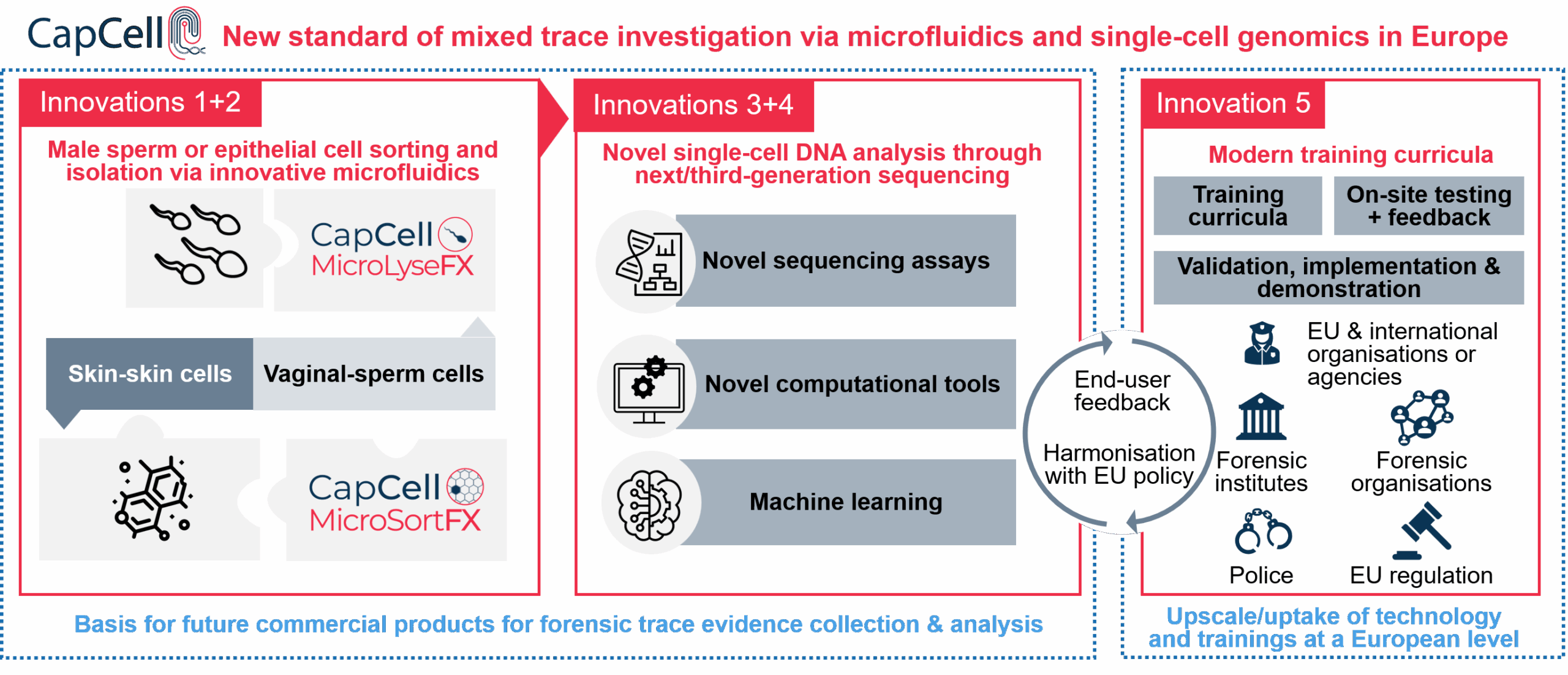
CapCell’s work focuses on five key innovations which are brought together in a validated toolkit for forensic scientists and police authorities.
Novel collection devices and protocols for postcoital swabs and trace evidence, optimised for single-cell analysis.
Microfluidics systems (MicroLyseFX and MicroSortFX) for the selection and isolation of sperm and male nucleated cells.
New single-cell DNA sequencing tools using capillary electrophoresis, massively parallel sequencing, and long-read sequencing.
Integrated analysis and interpretation tools including machine learning-based automation for forensic data processing.
A validated modular CapCell toolkit implemented and demonstrated in operational forensic environments.
Work plan
CapCell’s work is organised into seven interlinked work packages (WPs) that together deliver the project’s scientific, technical and societal objectives.
The consortium begins by identifying end-user needs and developing new microfluidic tools for isolating individual cells from complex biological traces. These are combined with cutting-edge sequencing and data analysis methods to enable reliable single-cell DNA profiling. The resulting CapCell toolkit will be validated and implemented by forensic institutes and police authorities, supported by training, communication, and exploitation activities to ensure lasting impact across Europe.